Online CasADi basic training
Getting up to speed with CasADi and optimal control.
This training is hands-on. Seminars are paired with computer exercises. The seminars give a bird’s-eye view of optimization and optimal control — a teaser for further study, or a recap for the experienced.
- For
- Academic and industrial researchers or tool-developers looking for practical ways to tackle large or complex continuous optimization problems, and optimal control problems in particular.
- Prerequisites
- No prior experience with CasADi required. Basic mathematical skills (analysis, calculus, linear algebra) and programming in MATLAB/Octave, Python, Julia or JavaScript.
- Software
- CasADi 3.8
- Format
- 6 weeks online trajectory with the Oct 2026 cohort · 24 hours of learning time · each week you can choose from two 3-hour live Q&A sessions where we work on exercises.
- When
- Cohort starting in 26 days: 13 Oct – 24 Nov 2026
After completion, you will be well-equipped to solve a broad range of engineering problems using CasADi by yourself.
What we cover.
Newton-type methods for constrained nonlinear programming – integration methods – direct transcription of optimal control problems (OCP) – model predictive control (MPC) – CasADi concepts, syntax and best practices.
12 modules of seminar and exercise, each with a pre-recorded solution. Open one to see the depth.
01 Rootfinding on a nonlinear set of equations: Newton's method
- The Newton step in a high-dimensional search space
- How (approximated) Jacobians are central to the method
- Using CasADi to evaluate Jacobians
- Common failure modes of Newton's method
02 CasADi basics: expression graphs and Functions
- A clear mental image of the basic CasADi concepts
- A consistent vocabulary for talking about CasADi
- Reasoning about CasADi types
- Reading CasADi error messages
03 Constrained nonlinear programming: Newton-type methods and interior point
- The conditions for optimality
- How Newton-type methods originate from rootfinding
- Building an SQP and an interior-point method in CasADi
04 Integration of CasADi integrator, rootfinder and nonlinear programming
- Composing CasADi building blocks to solve non-trivial engineering problems
05 The CasADi Opti stack for easy nonlinear programming
- Using Opti for nonlinear programming
- Simple debugging skills for common failure cases
06 Nonlinear programming for fitting problems
- How several fitting algorithms relate
- Using L1 and L2 norms in CasADi
- The robustness property of the L1 norm
- Solving a parameter-estimation problem from scratch in Opti
07 Direct methods for optimal control
- Single shooting and multiple shooting
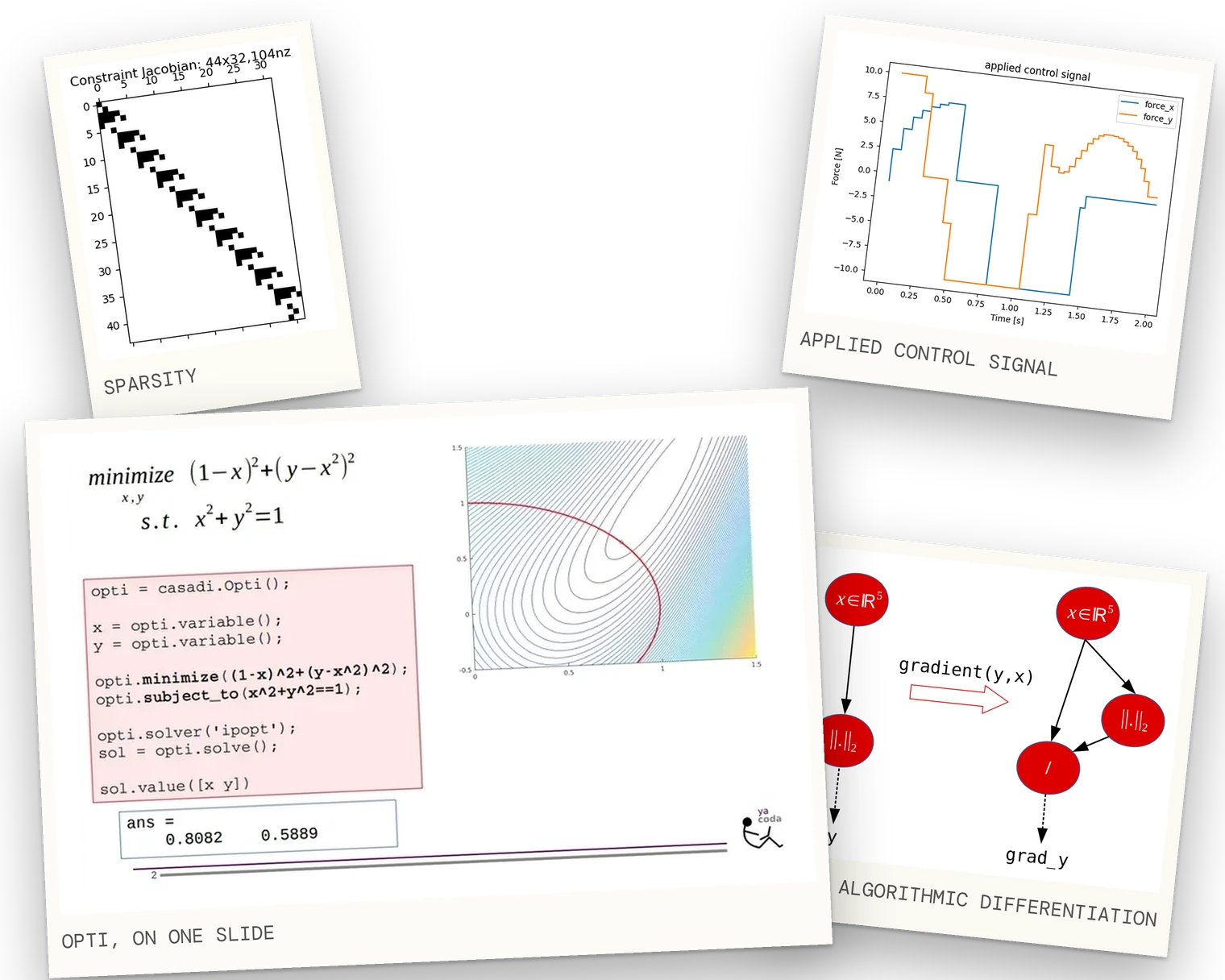
- The sparsity structure in multiple shooting
- Choosing between single- and multiple shooting
08 Implementing model predictive control in CasADi
- MPC as an extension of optimal control
- Speeding up a CasADi MPC problem
- Why MPC does not necessarily give a good controller
09 Time-optimal control in CasADi
- Why time-optimal control is intrinsically harder
- Trajectory tracking versus path tracking
- Periodic racing problems
- Interpreting Lagrange multipliers
10 Stochastic and robust constraints in optimal control
- Applying CasADi beyond ‘standard’ optimal control
11 Integration of system dynamics with collocation
- An intuitive understanding of a collocation method
- The connection to rootfinding
12 Direct collocation for optimal control
- How it differs from multiple shooting with a collocation integrator
- Implementing direct collocation
- The sparsity structure it produces
- The benefits of direct collocation
Pick a flavour.
Same course — on your own, with a live cohort*, or the complete package with one-to-one time.
Self-study
Guided
standard pickMentored
* It is well established that participation in a cohort (= group of people who all start at the same time) boosts completion rates for e-courses; most people are wired to feel more motivation when among peers.
What participants say.
Around 200 engineers and researchers have joined our CasADi courses since 2018. The voices below are participants of our earlier physical courses.
Highly recommended course for anyone interested in practical optimal control.
Very useful course for anyone willing to get started with (or learn the proper ways to use) CasADi.
Me and two colleagues followed the CasADi course in Leuven organized by Yacoda. It's a great open-source tool.
I liked the course a lot, and I especially appreciated the effort to expose us to as many topics as possible.